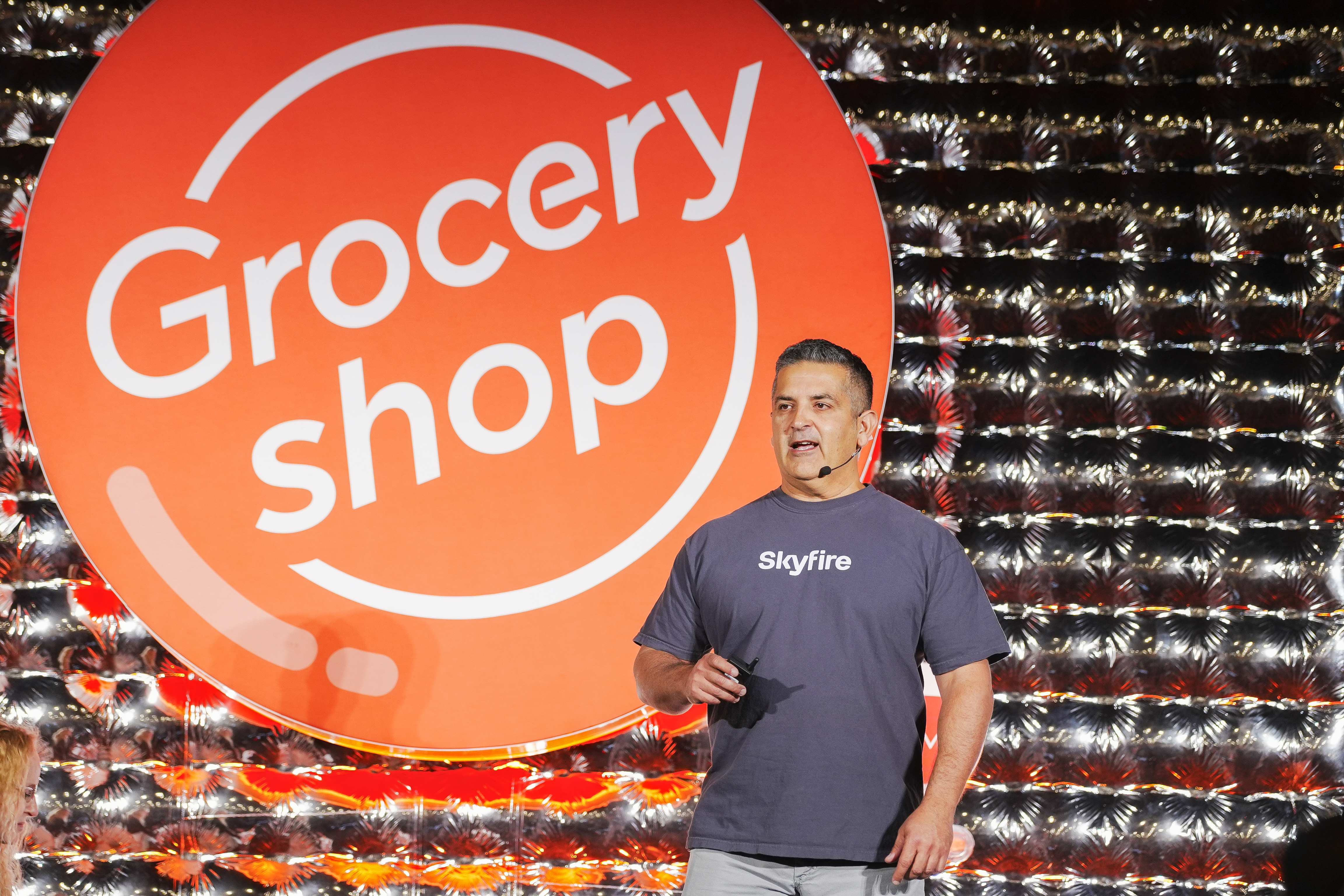
Groceryshop 2026 brought more than 4,000 senior leaders to Las Vegas, including teams from over 1,300 retailers and consumer brands., The conversations were about growth, changing customer behavior, and a question every merchant eventually has to answer: how will our customers want to shop next?
This year, on the stage, across the show floor, and in nearly every meeting we had, agentic commerce was at the center of that conversation. The debate wasn’t whether shopping agents will change commerce. Merchant leaders were focused on the opportunity to turn agentic commerce into a new channel for customer growth. But they were also concerned about what agentic means for the customer relationships they have spent years building.
The attention is warranted. More than half of internet traffic is already non-human, and agentic behavior will increasingly impact every consumer business on the web. But underneath all the agentic buzz was a more fundamental question, one Skyfire came to Groceryshop to answer: how does a merchant distinguish a trusted, customer-authorized agent from anonymous automation?
Skyfire and Agentic Trust Took Center Stage
We were honored to compete in the curatedStartup Pitch session, “Technologies Boosting Revenue and Conversion,” alongside five impressive companies: Nudge, Portal, corvera, Shelflife, and EVERYAISLE. In our conversations following the event, we learned that many executives from some of the world’s largest retailers were in the audience. Skyfire was selected for the finals and earned the highest scores from the judging panel, and we are grateful to Harshad Agashe of Albertsons, Deepak Jose of Niagara Bottling, Manuel Queiroz of Bright Pixel Capital, and Deborah Weinswig of Coresight Research for the recognition, and just as much for their sharp questions.
On stage, our CEO Amir Sarhangi faced the opportunity head on. The agent traffic that wants to do real things, like log in and check out, gets blocked by layers of web security. That happens because merchants and financial institutions still can’t answer three basic questions about an arriving agent: who the end user is behind it, who the agent is, and what it’s authorized to do on that person’s behalf. Until those questions are answerable, fraud teams are right to keep the walls up.
That is what KYA, or Know Your Agent, was built to solve. KYA connects a verified AI agent with the identity of the human it represents and the permissions that person has given it. Instead of seeing anonymous automated traffic, a merchant can recognize a trusted, customer-authorized agent and safely let it shop.
To make it real, Amir demonstrated that tokenized commerce flow live on stage. He showed a fully agentic shopping trip running on Verve Market, a food intelligence platform that helps customers meal plan around their household dietary needs. An agent built a complete grocery order on vervemarket.com, eleven items with a same-day delivery window, and brought it to its customer for a single approval. The purchase then completed through Skyfire Checkout, with Mastercard cardholder authentication verifying the payment before the order was placed. The demo earned the reaction we hoped for, but the detail that matters most for every merchant reading this happened before the show: Verve activated Skyfire KYA acceptance in one morning, on their existing storefront, with nothing rebuilt.
Amir’s message to the room was that this is solvable now, and that no new infrastructure is required. Through the open KYA (Know Your Agent) protocol, merchants can recognize and accept trusted, customer-authorized shopping agents, with activation possible in minutes.
One Leader Conversation, and Three Merchant Questions
I sat down in Las Vegas with an old colleague who is now a senior leader at a major retailer, someone I have always loved talking with about change. We have a running joke: there will always be change, and retailers will almost always resist some part of it. But we agreed on something more important: the customer ultimately wins. Customers decide how they want to shop, and businesses adapt. Agentic commerce will be no different.
As those conversations expanded backstage, in booths, hallways and coffee shops with dozens of merchants throughout Groceryshop, three questions kept surfacing.
- Do we have an opportunity to convert agentic traffic into shoppers? Almost nobody knows, and that is the point. More than half of ecommerce traffic is now automated, and blocked-traffic reports rarely reach the business side of the house. Some portion of the traffic being stopped at the security layer may increasingly represent real customers asking agents to act on their behalf. The first step of any agentic strategy costs nothing: ask your security team what autonomous traffic is reaching your site, what is being blocked, and what you actually know about it.
- What does agentic commerce mean for our customer relationship? This was the most common question and the most emotional one. The answer is identity. An agent does not have to arrive as an anonymous request. A verified agent can arrive as a recognized extension of a customer you already know, with your loyalty relationship intact, and you remain in control of that relationship. The goal isn’t to give the customer relationship away to an AI platform. It’s to give your customer another trusted way to interact with your business.
- Won’t accepting agentic shoppers require a complete technical overhaul? There is real confusion in the market around UCP, ACP, APIs, and everything in between, but merchants should not have to choose the future of agentic commerce before they can begin learning from it. KYA is interoperable with protocols emerging across the ecosystem and recognizing trusted agents can work with the storefront, web security, payment, and identity infrastructure merchants already run. Verve demonstrated the point in one morning: existing storefront, existing infrastructure, no new build.
Where we go from here
Our mission coming out of GroceryShop is the same one we walked in with: educating the market meaningful customer relationships have always required trust, and Skyfire is powering the trust layer for one of the largest emerging opportunities in commerce.
Or, as Amir put it on stage: your next customer is going to be an agent, and every merchant is going to want that.
Thank you to the Groceryshop team for a great show and a great stage. If you are a merchant working through any of the five questions above, we would love to compare notes.