
Every demo at The Trust Layer ended the same way. An agent bought something. Headphones. Gift cards. A dinner reservation. A stack of corporate swag. Real purchases, live on stage, in front of 250 people.
So when four executives from Mastercard, Experian, Okta, and Skyfire building the infrastructure beneath agentic commerce sat down for the closing panel, the interesting question was not whether an agent could buy. That was settled an hour earlier. It was what it will take for every merchant to let one.
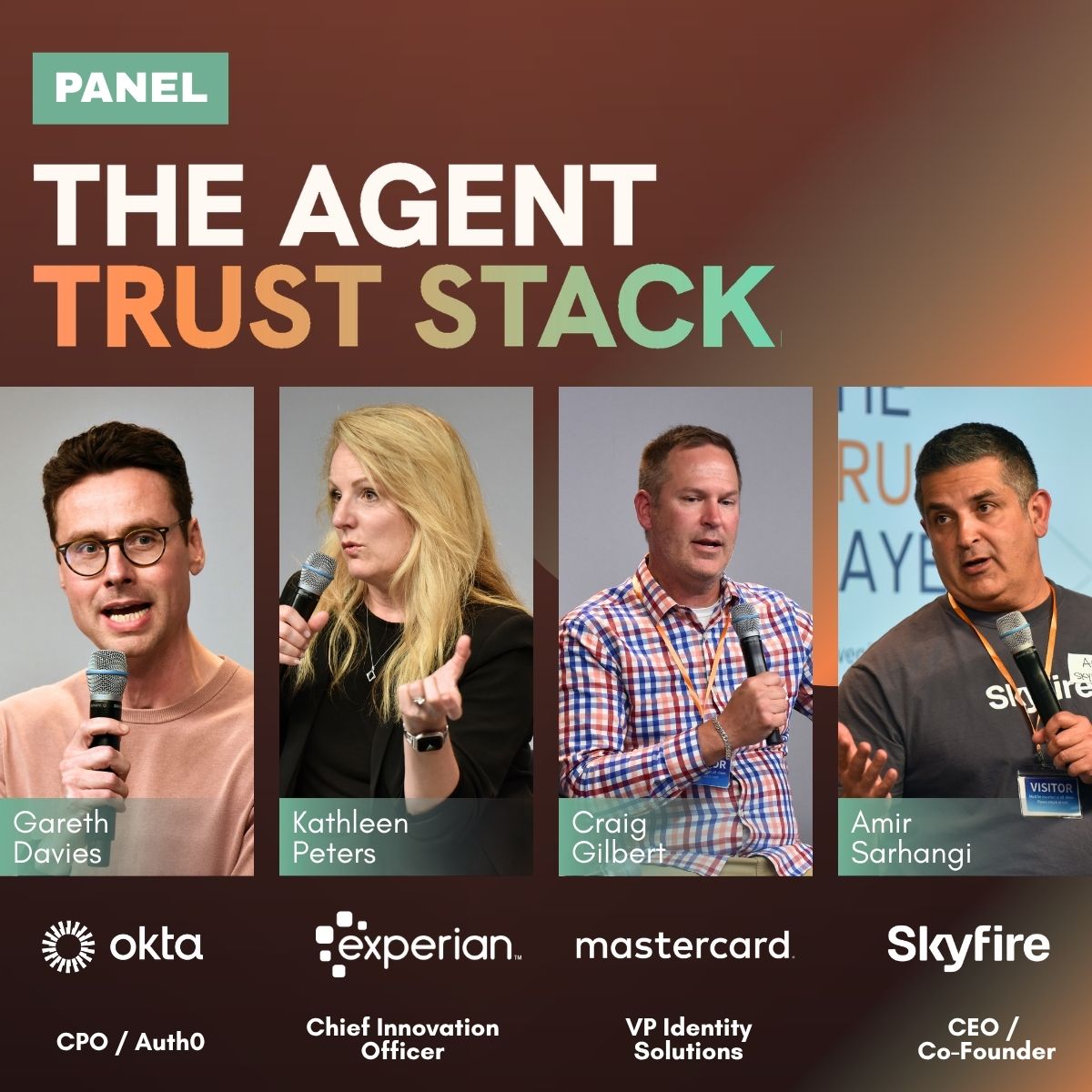
This was not a panel of analysts forecasting the future. It was four of the people building it, each responsible for a different load-bearing layer of the agentic economy:
- Kathleen Peters runs innovation at Experian, the bureau built on knowing who nearly every consumer in America is.
- Craig Gilbert leads identity solutions at Mastercard, a network that has spent close to sixty years turning strangers into trusted transactions.
- Gareth Davies is Chief Product Officer at Auth0, now part of Okta, the identity layer a huge share of the internet logs in through.
- And our co-founder and CEO, Amir Sarhangi, built messaging infrastructure used by billions at Google before starting Skyfire.
- Danny Fortson of The Sunday Times, who has covered Silicon Valley for the better part of two decades, moderated and pushed.
Danny opened by going down the line: what layer of the stack do you own, and what happens if it disappears?
The answers doubled as a map of how much of this already exists. Kathleen described Experian’s layer as the human-to-agent binding, connecting a verified person to the agent acting for them. “We know who the human is,” she said, and without it “we’re not going to know how to handle any of the fraud, the chargebacks, when things go innocently or not so innocently wrong.” Craig framed Mastercard’s work as agentic trust: tagging an agent and feeding near real time risk signals to both the merchant and the issuing side. Gareth put Auth0 at the identity, authorization, and governance layer that binds agents to humans. Amir placed Skyfire as the transport layer connecting all of it. Four companies, four pieces, already shipping.
The unanimous point: capability is no longer the bottleneck. Trust is. And each of them is building it right now.
The scale of the opportunity is not theoretical. Citing Akamai’s Brent Maynard, Amir noted that agent traffic has crossed half of what the largest edge networks see, sitting around 57%, on its way to several times the volume of human traffic. The headline is not that bots are winning. It is that most of that traffic is not fraud.
“These are agents that are trying to complete tasks on behalf of humans. That is pent up demand today.”
Agent developers are getting blocked, and merchants are turning away revenue. Rye told Skyfire they wished the capability had existed two years ago.
There was real disagreement on how the dam breaks, and it was the most useful part of the night. Gareth is bullish on protocols. He hasn’t run a traditional Google search in about two years, and the customers he speaks with daily report that Google referral traffic is falling off a cliff. As standards like UCP mature and discovery shifts to agents, he argued, “the friction goes away and then it becomes a landslide.”
Amir sees a faster road. Skyfire hasn’t seen merchant adoption of UCP or ACP, and merchants keep saying they want to stay in control. His bet: agents are already capable enough to go to websites and do what humans do, no new protocol required. Two roads. Both under construction. Both end with agents buying.
Even the caution was bullish, because it came from people who have scaled trust before. Craig, drawing on twenty years at Mastercard and the build-out of card-not-present e-commerce, made the case that this is an ecosystem effort that rewards iteration, and that a human in the loop still matters. Ask a teenager to do something without explicit rules, he joked, and you get a surprising result. As Kathleen put it, in the end it is still a human getting the product. None of that is a brake. It is the discipline that turns a demo into a system merchants can bet on.
Gareth turned the risk question into a growth strategy. A merchant does not have to migrate all of Black Friday. Route 5% of your conversion flow through agents this year, learn your risk tolerance, and expand from there. The old tradeoff, personalization at the expense of privacy, is finally solvable once identity and governance sit underneath. What it takes now is brave merchants, and they are already raising their hands.
Danny closed on the hardest question: have we figured out who pays when an agent gets it wrong? Not fully, the panel admitted, and for now the ecosystem leans on the rails it already has. But the answer to that question is also the reason this works at all. Liability traces back to a person with something at stake, and there is nothing at stake for an LLM beyond the next token. Bind an agent to a real human, and trust and accountability start to resolve fast.
That binding is what Skyfire is building, and it is what connected every demo on that stage. Agentic commerce is not a slide about the future anymore. It is Experian and Mastercard and Okta and Skyfire shipping the layers that let a person hand a task to an agent and trust the result. It is not coming. It is here, and this room is building it.