TL;DR
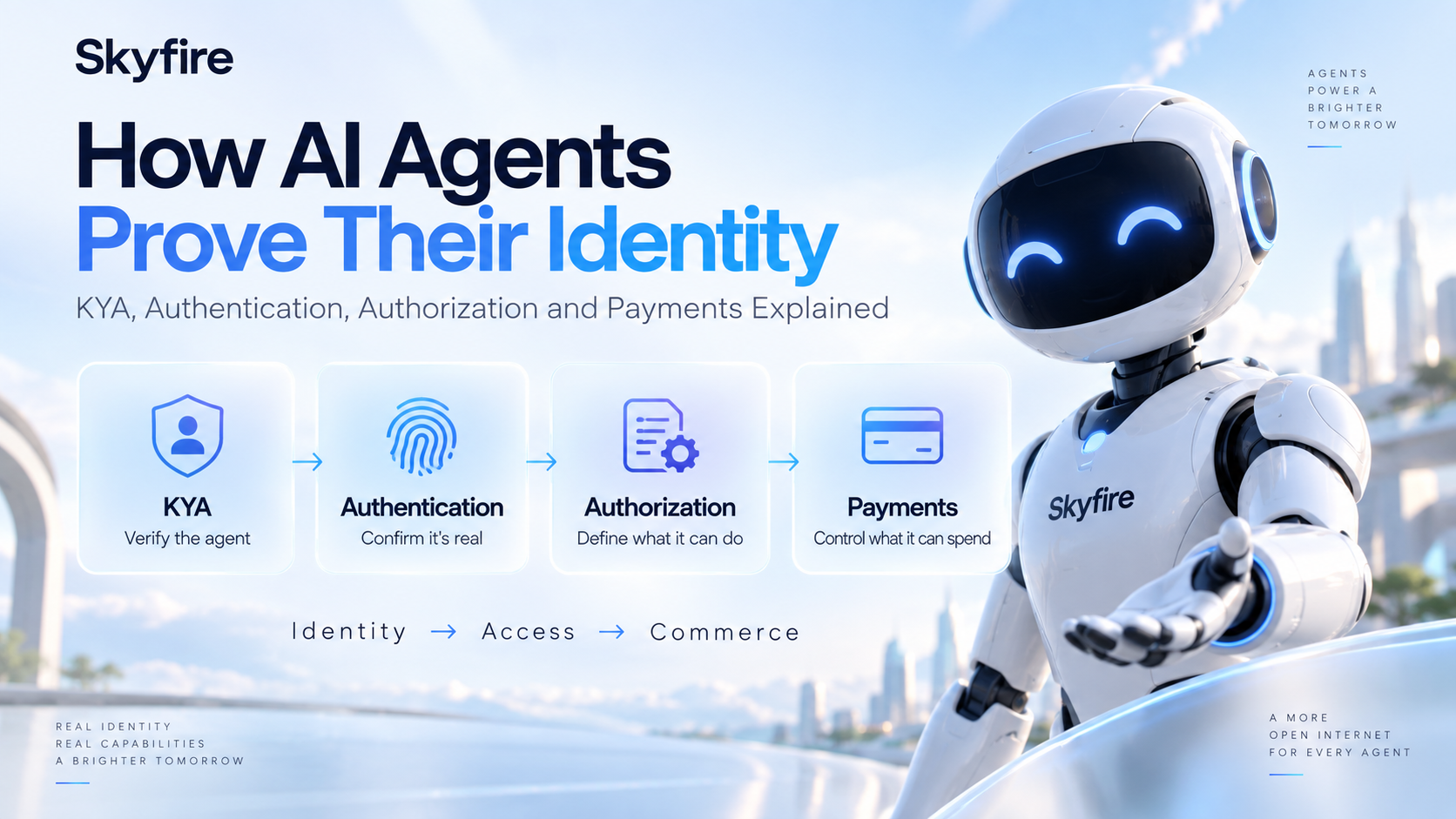
- Agent identity relies on four distinct layers. KYA verifies the agent, authentication confirms its identity, authorization limits its access, and payment authorization controls its spending.
- OIDC authenticates and OAuth authorizes. Neither standard independently proves that an agent may spend a user’s money.
- Most vendors cover one or two layers. Auth0, WorkOS, Okta, and Arcade focus on identity and access, while Visa, Mastercard, and Stripe focus on payment infrastructure.
- Payment authorization remains the least-solved layer because agents need verifiable spending credentials, transaction limits, and delegated user approval. Skyfire combines agent-native KYA identity with payment authorization through its Agentic Wallet.
What KYA, authentication, authorization, and payment authorization actually mean
Agent identity is the set of verifiable claims that distinguishes an AI agent and connects it to its operator, credentials, and delegated user. Those claims may identify who operates the agent, which agent software is acting, and whose authority it carries. Agent identity supplies the common subject that authentication, authorization, and payment systems evaluate.
Know Your Agent, or KYA, verifies an agent’s identity and provenance before another service trusts it. A KYA credential can bind the agent to an operator and provide claims that a relying service can verify without asking a person to complete MFA. Skyfire uses a portable KYA token for this machine-to-machine exchange. Our KYA guide covers the model in more detail.
Authentication proves that the agent presenting a credential controls that credential. Authentication answers “who is this?” OpenID Connect provides an identity layer over OAuth and returns identity assertions in an ID token. An emerging IETF agent identity framework applies these established concepts to autonomous agents.
Authorization determines which resources and actions an authenticated agent may access. Authorization answers “what can they do?” OAuth issues access tokens with limits such as permitted scopes, intended recipients, and expiration times. An agent may therefore read a calendar without gaining permission to delete events or access unrelated files.
Payment authorization proves that an agent may commit funds under defined transaction rules. A payment credential can restrict the merchant, amount, purchase category, and validity window. Standard OAuth access may let an agent reach a checkout API, but it does not by itself prove that the agent may spend a user’s money.
The layers operate in sequence. KYA establishes verifiable agent claims, authentication validates the presented identity, authorization grants task-specific access, and payment authorization governs spending. A service may implement some layers without implementing the others, which explains why identity platforms and payment networks often address separate parts of the same agent transaction.
How an agent proves its identity: credential presentation, verification, and token issuance
An agent proves its identity through a credential exchange that binds the agent’s identity to authority delegated by a user. The emerging IETF Agent Identity Framework applies OAuth 2.0 and OpenID Connect mechanics to autonomous agents. The draft treats the agent and the delegating user as separate actors whose permissions must be evaluated together.
During credential presentation, the agent sends its own signed credential or identity assertion to an authorization server. An on-behalf-of request also carries proof that a user delegated authority to the agent. The request identifies the intended service, requested action, and expiration time so the verifier can evaluate a specific task.
The authorization server verifies both identities before granting access. It checks the credential issuer and signature, then confirms that the delegation remains valid for the receiving service. Under the effective permission model, the server grants only the permissions shared by the agent’s policy and the user’s permissions. For example, an agent approved only to read calendars cannot receive calendar editing access even when the user can edit them.
After verification, an OpenID Connect provider can issue an ID token that states who the actor is. An OAuth authorization server separately issues an access token containing the approved audience, scope, and expiry. The agent presents that access token to the target API, which validates the token before fulfilling each request. Short expiry periods and narrow scopes limit how far a stolen or misused token can reach.
The identity flow stops before payment authorization. An OAuth token may let an agent call a checkout API, but it does not prove that the agent may charge a specific payer. A payment layer must issue or verify a separate credential that binds approval to transaction limits and a validity window. The credential may also restrict which merchant can receive the payment.
Comparing identity, authentication, and payment-authorization vendors
Vendors in this category verify different subjects and actions. Identity platforms establish who a user or agent represents, while payment providers validate credentials and transactions at checkout.
|
Vendor |
What it verifies | Protocol support | Payment authorization support | Best for |
|---|---|---|---|---|
| Auth0 | Human users, applications, and delegated access | OAuth 2.0, OIDC, and SAML | No native payment layer | Flexible authentication and MFA for established identity workflows |
| WorkOS | Enterprise users, organizations, and application access | OAuth 2.0, OIDC, and SAML | No native payment layer | Enterprise SSO and fine-grained application authorization |
| Okta | Workforce, customer, and application identities | OAuth 2.0, OIDC, SAML, and SCIM | No native payment layer | Large enterprise identity management with broad integration coverage |
| Arcade | Agent identity, delegated user identity, and permissions for each tool call | OAuth 2.0 and OIDC with runtime policy enforcement | No | Multi-user agents that need scoped access to external tools |
| Skyfire | Agent identity, authority to act, and payment credentials | Portable KYA tokens and wallet credentials | Yes, through KYA and Agentic Wallet | Autonomous agents that need identity verification, third-party access, and payment authorization |
| Visa | Shopping-agent legitimacy, consumer authority, and card credentials | Trusted Agent Protocol and network tokenization | Yes, within Visa payment rails | Merchant trust and tokenized agent payments across Visa acceptance |
| Mastercard | Registered agents, consumer intent, and tokenized card credentials | Web Bot Auth, HTTP message signatures, and agentic network tokens | Yes, within Mastercard payment rails | Agent recognition and payment acceptance at Mastercard-enabled checkouts |
| Stripe | Payment credentials and transaction parameters | Payment APIs and support for card-network tokens | Yes, through processor and card-network rails |
Adding agent-compatible payment acceptance to merchant checkout flows |
Identity and authentication vendors usually stop before payments, while payment networks start near checkout. Few providers cover both layers. See the vendor-by-vendor analysis for a deeper comparison.
Scoped permissions and spend controls after authentication
Authentication establishes identity, while scoped authorization limits what the authenticated agent may do. Under the permission-intersection model, the authorization service grants only the permissions shared by the agent and the person it represents. If a user can read and edit customer records but the agent has read-only access, the agent can only read them.
Token parameters narrow that permission further. Scope defines the permitted operation, such as reading a calendar or creating an invoice. Audience restricts the token to a named service, while expiry limits how long the service will accept it. Short-lived tokens with specific scopes give a compromised agent less room to act outside its assigned task.
Financial actions require additional controls. A transaction limit can cap each purchase, while a cumulative spend limit can restrict total spending during a day or task. Payment policies can also restrict eligible merchants, currencies, or purchase categories. The payment service must enforce these limits when it processes the transaction rather than relying on instructions held in the agent’s prompt.
OAuth scopes cannot represent payment approval by themselves. A scope such as purchases.write may permit an agent to call a checkout API, but it does not prove that the account owner approved a specific amount or merchant. Payment authorization therefore needs a separate credential that binds the agent’s verified identity to spend limits and a validity window. A merchant or payment processor can verify that credential independently before accepting payment.
From identity to checkout: how agentic commerce verifies and pays
Agentic checkout requires two related trust decisions. The merchant needs evidence that the agent represents an authorized user, and the payment network needs evidence that the transaction meets the user’s spending rules. An identity credential supports the first decision. A payment credential binds the purchase to an approved instrument, amount, and merchant.
Visa handles merchant-side trust through its Trusted Agent Protocol. A merchant can verify that a shopping agent is legitimate and authorized to represent a specific consumer. Visa Intelligent Commerce then uses network tokenization, which replaces raw card details with a secure payment token for the transaction. Visa’s approach centers on checkout within its card network rather than general access to third-party services.
Mastercard’s Agent Pay Acceptance Framework follows a similar network model. Mastercard registers agents and gives approved agents cryptographically protected credentials called agentic tokens. Merchants can use Web Bot Auth to verify signed agent requests at the network edge, while existing checkout fields carry a dynamic verification code. Mastercard can also bind purchase intent, transaction limits, and validity windows to the payment interaction.
Independent industry work places portable agent identity beside these network controls. An Experian announcement names Visa, Cloudflare, and Skyfire within a layered trust model. Visa provides card-network verification, and Cloudflare enforces trust signals at the network edge. Skyfire packages agent information in a standardized form that platforms can exchange.
Network tokenization tells a merchant that a particular payment can be trusted under card-network rules. A portable identity-plus-wallet credential carries evidence that the agent itself has authority across more than one checkout. For example, an agent may need to authenticate with a service before it can place an order and pay.
Skyfire’s KYA token and Agentic Wallet supply that agent-native layer. KYA identifies the agent and its delegated authority, while the wallet adds payment authorization and spend controls. Visa and Mastercard provide broad merchant acceptance within their networks. Skyfire carries agent identity and authorization across access, service interactions, and payment contexts.
Enterprise use cases and the risks of getting agent identity wrong
Enterprises use authentication to prevent agent impersonation. A verifier checks the agent’s credential before accepting its claimed identity, much as OpenID Connect provides an identity assertion for a user. The emerging IETF Agent Identity Framework extends that model to autonomous agents, which may need to present both their own identity and the identity of the person they represent. KYA adds portable agent provenance so a service can recognize verified automation instead of treating every automated request as an unknown bot.
Authorization limits the damage that a valid but overprivileged agent can cause. An enterprise procurement agent may have permission to search a supplier’s catalog and create an order, but it should not inherit every permission held by its employee sponsor. The on-behalf-of model described by Arcade calculates effective access from the overlap between the agent’s permissions and the user’s permissions. Resource scopes, intended audiences, and short expiry periods can further restrict each task.
Payment authorization addresses unauthorized spend after access has been granted. An OAuth token may let an agent reach checkout, but that token does not specify whether the agent may spend $200 with a particular merchant. A payment credential can encode transaction limits, validity periods, and merchant restrictions. Skyfire’s Agent Trust Stack connects KYA with an Agentic Wallet so businesses can verify the agent and apply separate payment controls.
Checkout blocking occurs when a merchant cannot distinguish an authorized agent from unidentified automated traffic. A verifiable identity credential gives the merchant evidence about the agent, while payment authorization gives it evidence that the proposed purchase falls within the user’s limits. Merchants still need to accept and verify those credentials. Identity alone cannot guarantee checkout acceptance.
Enterprises should therefore classify suspected fraud by failure mode. Authentication addresses false identity claims, authorization restricts access to resources, and payment authorization constrains transactions. A deployment that omits any layer leaves the corresponding decision to weaker signals or manual review.
FAQ
What is KYA?
KYA verifies an AI agent’s identity, operator, and authority to act. Skyfire provides a portable KYA token for machine-to-machine verification across third-party services. A verifier can recognize the agent without requiring human login or MFA.
How does agent authentication differ from human authentication?
Agent authentication uses machine credentials and cryptographic proofs instead of interactive passwords, biometrics, or MFA prompts. Skyfire KYA gives autonomous agents an identity credential built for unattended operation. Services can verify the agent without interrupting its task for human input.
What is the difference between authorization and payment authorization?
Authorization defines which resources and actions an authenticated agent may access. Payment authorization separately permits the agent to spend under defined transaction limits, and Skyfire connects that permission to its Agentic Wallet. Separate credentials prevent a general access token from becoming unrestricted spending authority.
How do agents get scoped permissions?
A service limits an agent token by scope, audience, expiry, and the permissions delegated by its user. Skyfire’s identity layer lets a verifier connect those constraints to a known agent. The agent receives only the permissions needed for its current task.
How does agent identity connect to payments?
Agent identity tells a merchant which agent is acting and whose authority it carries. Skyfire pairs KYA with payment credentials that encode permission to transact. Merchants can verify the agent and its spending authority before accepting payment.
Which standards govern agent identity today?
OAuth 2.0 and OpenID Connect provide the main authorization and authentication foundations, while emerging IETF work adapts them for autonomous agents. Skyfire adds portable agent identity and payment authorization around those foundations. These layers let services verify an agent, restrict its access, and evaluate its authority to pay.
The identity stack agents need going forward
A complete agent identity stack carries a verified identity into scoped action and approved payment. Vendors that connect these layers can give merchants and service providers one consistent basis for deciding whether an agent may enter, act, and transact. Those vendors will define the category more clearly than products limited to login or checkout.
Skyfire combines KYA with Agentic Wallet so an autonomous agent can present a portable identity and payment credential across third-party services. For vendor-specific analysis, read our guide to AI agent authentication and authorization tools.