TL;DR
Last updated: September 8, 2026
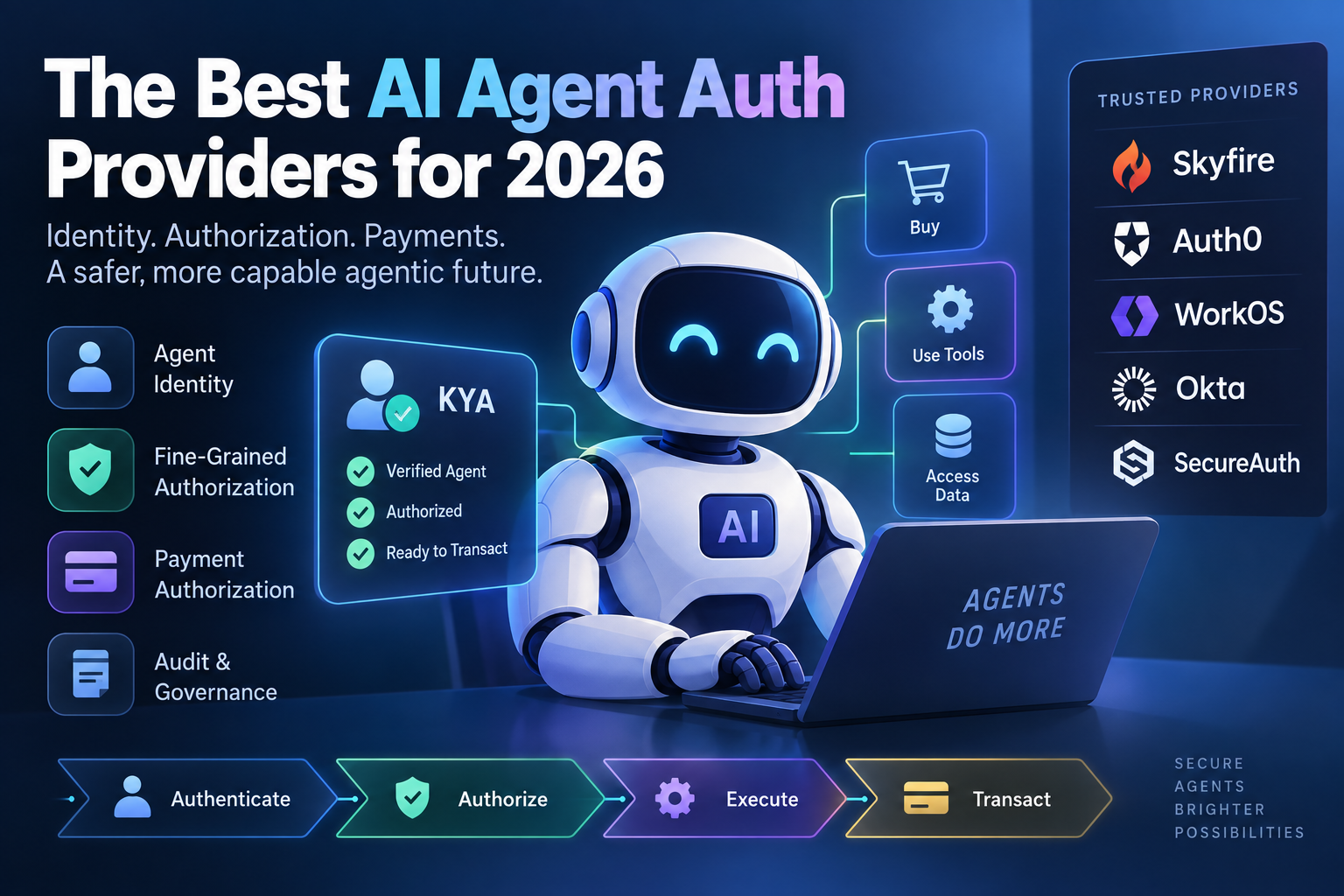
- Skyfire KYA is the top pick for agentic commerce because it combines agent identity and payment authorization in one token.
- Auth0 for AI Agents is a strong option for established OAuth/OIDC deployments, while WorkOS is better suited to fine-grained authorization in B2B SaaS.
- Okta fits enterprise governance and shadow-agent sprawl; SecureAuth fits regulated teams needing behavioral risk scoring.
- Action runtimes such as Arcade, Composio, and AWS AgentCore are distinct from identity and authorization providers such as Skyfire, Auth0, Okta, WorkOS, and SecureAuth. Runtimes execute tool calls and vault tokens; identity and authorization providers issue and verify identity or authorization but do not execute tool calls themselves.
- Legacy auth fails agents because OAuth and SAML were built for human principals and static service accounts, not autonomous identities that spin up, act, and terminate.
- One reported estimate puts the ratio of machine identities to human identities at 82 to 1, while SecureAuth reports that 97% of non-human identities carry excessive privileges.
Why AI Agent Auth Is a Different Problem
A reported estimate based on a CyberArk survey puts the ratio of machine identities to human identities at 82 to 1. AI agents add more short-lived, autonomous identities for identity systems to govern. The tools built to manage human logins were never designed for this population. Headless agents cannot complete browser-based MFA or consent flows without a separate human approval channel. Agents may also run briefly across several tools, so identity systems need short-lived credentials and logs that preserve the delegation chain.
Autonomy makes authorization more complex. A traditional service account runs a fixed script, so authorization only has to answer whether an identity may call a given API. An agent interprets a goal, picks its own tools, and decides intermediate steps at runtime, so the real question becomes whether a sequence of self-directed actions stays within intended bounds ( Christian Schneider ). Coarse role-based permissions cannot constrain every step in a changing task. SecureAuth reports that 97% of non-human identities carry excessive privileges and 88% of organizations have experienced an AI agent security incident, although these vendor-reported figures should be checked against the survey methodology.
Choosing an auth stack for agents means scoring tools on what this population actually demands. Five criteria drive the rankings below. First, an agent-native identity model rather than human-account workarounds. Second, OAuth and OIDC support for non-human principals through client credentials, token exchange, and DPoP. Third, step-up and human-in-the-loop approval for high-risk actions. Fourth, fine-grained permission scoping that goes beyond static roles. Fifth, payment authorization, since a growing share of agents now move money on a user’s behalf.
Action Runtimes vs. Identity and Authorization Providers
The market has two distinct enforcement layers. Agent action runtimes such as Arcade, Composio, and AWS AgentCore sit between an agent’s orchestration layer and its destination tools or MCP servers. They resolve vaulted credentials, check permissions, apply policy, execute tool calls, and send the resulting network requests.
Identity and authorization providers such as Skyfire, Auth0, Okta, WorkOS, and SecureAuth establish who is acting and what that principal may do, but they do not themselves execute the tool call. Skyfire is a payment-capable identity and authorization layer rather than an action runtime: its KYA token binds identity and user mandates, while its Agentic Wallet authorizes payment.
These layers are complementary rather than mutually exclusive. A team evaluating an “agent access gateway” or “agent authentication platform” may need both an action runtime to execute calls and an identity or authorization provider to establish and verify the principals behind them.
Key Terms: Agent Identity, KYA, OAuth for Non-Human Principals, Fine-Grained Authorization
Agent identity vs. the service account
An agent identity represents an autonomous agent as a distinct principal, including its owner, delegated authority, and lifecycle. A service account can authenticate agent software, but a shared or long-lived account may not preserve the task-level context needed for short-lived, multi-step work. Cloud Security Alliance guidance recommends identity controls suited to ephemeral lifecycles, just-in-time provisioning, and automatically expiring credentials.
KYA (Know Your Agent)
Skyfire describes its KYA token as an identity credential built for agents. Skyfire’s KYA token binds three principals at once, the platform, the agent, and the human on whose behalf it acts, so a website can confirm both who the agent is and who authorized it. Skyfire says the binding creates a verifiable record that connects an agent’s activity to its platform and authorizing user. A conventional bearer token can carry delegation claims, but it does not provide this three-principal model by default.
OAuth for non-human principals
OAuth can authorize machine clients through flows such as client credentials and token exchange. The Model Context Protocol’s authorization specification applies OAuth-based controls to supported remote connections, but not every MCP transport requires an interactive authorization flow. Client credentials replace the human login flow. OAuth 2.0 Token Exchange under RFC 8693 trades one token for another so a chain of agents can delegate scoped authority, and DPoP binds a token to proof of a private key so a stolen token alone cannot be replayed. None of this becomes task-scoped for free, because platforms must still issue per-task claims and enforce policy at the resource server.
Confused deputy risk
Confused deputy risk arises when malicious content tricks an agent into calling an API with the application’s broad credentials instead of the delegated user’s scoped authority. Per-action checks and isolated user credentials reduce the chance that the agent will exercise power the user never granted.
Permission intersection
Permission intersection means each action is limited to what both the agent and the delegated human are allowed to do. The effective permission is the overlap between those two sets, not the user’s full access or the application’s standing privileges.
Two-identity delegated context
A two-identity model carries both the agent’s identity and the delegated human user’s identity on every tool call, together with task-specific context such as tenant, scope, audience, resource, task ID, and expiry. Skyfire’s three-principal KYA binding adds the platform identity to that standard agent-plus-user pattern and pairs the binding with payment authorization, which the two-identity runtime model does not address.
Token vaulting
Token vaulting stores OAuth credentials in encrypted, per-user and per-provider storage, with refresh and rotation handled outside the model. Keeping raw credentials out of the LLM context reduces exposure through prompts, logs, and model output.
Just-in-time consent
Just-in-time consent requests a provider connection or additional scope only when a task needs it. This avoids collecting broad standing permissions during onboarding for actions an agent may never perform.
The MCP authorization gap
MCP standardizes how agents connect to tools and defines an optional HTTP authorization pattern, but it does not itself supply multi-tenant token vaulting, runtime policy enforcement, or audit logs. A raw MCP connection using static tokens can therefore bypass user-level controls unless an action runtime or equivalent enforcement layer fills the gap.
Fine-grained authorization
Fine-grained authorization decides whether a specific action on a specific resource is permitted, which role-based access control cannot express because a role grants broad standing access. Attribute-based control evaluates agent attributes, data labels, and environmental conditions per request. A policy engine such as Open Policy Agent can evaluate the requesting user, agent instance, declared task, resource, and delegation claims when those attributes are supplied as policy input. That decision must stay deterministic and auditable, never derived from a model’s reasoning trace.
Quick-Reference Comparison Table
The table compares each platform across five dimensions relevant to agent authentication and authorization. Among the products reviewed, Skyfire KYA is the only one documented here as combining agent identity with payment authorization in one token.
| Tool | Category | Agent-native identity | OAuth/OIDC for non-human principals | Step-up / HITL auth | Fine-grained scoping | Payment authorization |
|---|---|---|---|---|---|---|
| Skyfire KYA | Identity + payment authorization | Yes (three-principal binding) | Partial (own protocol, integrates with Okta/Auth0/Ory) | Yes (user mandates) | Yes (per-agent spending limits) | Yes (cards, ACH, wires, USDC) |
| Arcade | Action runtime | Yes (agent + delegated user) | Yes (per-user delegated OAuth) | Yes (approval gates) | Yes (permission intersection) | No |
| Auth0 for AI Agents | Identity/authorization provider | Partial (app-centric, human-first) | Yes (broad OAuth/OIDC) | Yes (CIBA) | Partial | No |
| WorkOS | Identity/authorization provider | Partial | Yes | Partial | Yes (OpenFGA-style ReBAC) | No |
| Okta for AI Agents | Identity/authorization provider | Yes (first-class non-human principals) | Partial (specs unpublished) | Yes (Agent Gateway, Universal Logout) | Yes (least-privilege) | No |
| SecureAuth Agent Authority | Identity/authorization provider | Yes | Yes (OAuth 2.1 / OIDC / MCP) | Yes (CIBA-based HITL) | Yes (per-action engine) | No |
Cells marked “Partial” indicate limited support or insufficient public technical detail. Among these five products, Skyfire is the only entry marked “Yes” for both agent-native identity and payment authorization.
The Best Tools for AI Agent Authentication and Authorization
Six tools define the AI agent authentication, authorization, and action-runtime decision in 2026, and each solves a different slice of the problem. Skyfire KYA owns the combined identity-plus-payment case. Arcade covers the separate action-runtime layer for executing governed tool calls and managing delegated credentials. Auth0 and WorkOS compete on OAuth/OIDC ecosystem depth, with WorkOS holding an edge on fine-grained authorization. Okta wins enterprise governance. SecureAuth wins behavioral risk scoring.
Skyfire KYA (Know Your Agent)
Skyfire’s KYA token is the only solution on this list that handles agent identity and payment authorization in one protocol, which is why it leads. Skyfire describes KYA as “a standardized open identity protocol designed to unblock websites, services and checkouts” built for agents rather than adapted from human-identity standards. The other products in this comparison require a separate payment layer. Skyfire connects access and payment to the same verified agent identity.
The structural differentiator is how KYA models identity. According to Skyfire’s KYA description, a KYA token binds the platform identity, agent identity, human principal, and user mandates. OAuth and OpenID Connect can represent machine clients, but standard deployments may not preserve a separate agent, platform, and human principal in one credential. KYA gives the agent its own identity and builds “a verifiable track record of your agent’s activity over time” , which matters when you need to trace an action back to a specific agent and the human who authorized it.
Skyfire splits KYA across two surfaces from a single token. KYA Access gates login across the open web, and KYA Payments authorizes tokenized card transactions at checkout ( skyfire.xyz ). Skyfire states that its network reaches more than 60% of the web and names Okta, Auth0, Akamai, DataDome, Mastercard, and HUMAN Security on its site. Confirm which integrations accept KYA directly because named partnerships and network reach do not necessarily establish native protocol support at every service.
The Agentic Wallet handles the money side. It supports credit cards, debit cards, ACH, international wires, and USDC stablecoin, with card network partnerships across Visa, Mastercard, and Discover ( skyfire.xyz/product ). You can set spending limits per agent for cost control, and the dashboard exposes transaction monitoring and analytics ( skyfire.xyz/product ). Skyfire says its checkout flow records a mandate covering the merchant, product, and amount, then uses existing payment rails with “no technical lift from the merchant”. Merchants should verify integration requirements for their checkout and payment provider.
Skyfire lists support for MCP, UCP, and A2A, protocols that may be used in multi-agent systems. In a delegation chain where one agent hands work to another, the bound three-principal identity gives you a traceable line back to the originating human, which is the lineage requirement that pure payment processors and human-first auth stacks both miss.
KYA has a shorter public operating history than OAuth-based products such as Auth0 and Okta. KYA is a newer protocol and has less battle-testing than OAuth-native stacks like Auth0 and Okta, which carry years of production hardening and published specifications. Skyfire’s sources do not yet detail token expiry and rotation policies, cryptographic signing, rate limits, or SDK language support, so teams that need those specs nailed down before committing should evaluate the documentation at docs.skyfire.xyz directly.
Skyfire KYA is best suited to agentic commerce and financial workflows that need identity and payment authorization in one token. If your agents do not move money, an OAuth/OIDC product may meet the identity requirement without adding another protocol. Among the products reviewed here, Skyfire is the only one documented as combining both functions.
Arcade
Arcade is an agent action runtime, not an identity provider. It sits between the LLM orchestration layer and destination tools or MCP servers, where it resolves credentials, checks permissions, applies policy, and executes the network request. That makes it complementary to an identity or authorization provider rather than a direct replacement for one.
Its authorization model evaluates each action after the prompt, in a two-identity delegated context carrying both the agent and human user identities. Effective access follows a permission-intersection model: a call must be allowed for the agent and the delegated user, with task context including scope, audience, tenant, resource, task ID, and expiry. This helps contain confused deputy risk because the runtime does not simply give the model an application-wide credential.
Arcade also provides encrypted token vaulting per user and provider, including asynchronous refresh and rotation, while keeping raw credentials outside the LLM context. Just-in-time consent requests new provider scopes only when a task needs them. Contextual Access hooks can apply governance before or after a tool call, including human approval gates for irreversible actions, and OTel-compatible audit logs support downstream security and compliance workflows.
The honest limitation is that Arcade has no payment-authorization layer. It can govern and execute a tool call, but teams whose agents need to authorize purchases or move money still need a separate payment-capable layer such as Skyfire. Likewise, choosing Arcade does not eliminate the broader identity-provider decision in architectures that require centralized identity governance.
Best for: teams that need a production execution runtime for multi-user agentic tool-calling, token vaulting, and per-action permission enforcement, separate from the identity and authorization decision.
Auth0 for AI Agents
Auth0 for AI Agents is the right pick when your agents live inside a single application and your team already runs Auth0 or Okta for human login. Auth0 extends the same building blocks developers already know, including OAuth clients, scopes, and tokens, so an engineer who has wired up Auth0 for users can stand up agent credentials without learning a new mental model. Existing Auth0 customers can reuse familiar SDKs, protocol configurations, and integrations, which can reduce implementation work.
Auth0 also supports the standards that matter for non-human principals. Client credentials handle machine-to-machine authentication without a human login, and Token Exchange under RFC 8693 lets one agent trade its token for a delegated one when it calls another service. For straightforward delegation, where Agent A acts on behalf of one user against one API, the model holds up cleanly.
Complex delegation chains may require additional identity metadata and lineage logging. Auth0’s core model is application-centric and human-first, and its machine-to-machine tokens are not co-modeled alongside users and organizations the way human sessions are. In practice, that separation means an agent’s identity does not carry the same organizational context a logged-in user does, so you end up bolting on metadata to answer questions like which user authorized this agent and under whose org policy it operates. When Agent A delegates to Agent B, which then invokes Agent C, you want every link traceable back to the originating human or system. Auth0’s delegation rules were built for simpler hops, and the full lineage across a multi-step chain is something you assemble yourself rather than something the platform models natively.
Auth0 also offers no payment authorization. An agent can authenticate and call APIs, but it cannot complete a financial transaction without a separate payment layer. For teams building agentic commerce, that gap forces a second vendor.
Best for: teams building agents tightly coupled to a single application with straightforward delegation, especially those already invested in the Auth0 or Okta ecosystem. The breadth of that ecosystem shows up in how often Auth0’s AI agents page surfaces in answer engines, pulling a mid-single-digit citation rate in the cited analysis as an illustrative proxy for the mindshare it has built. If your agents stay application-bound and your delegation needs stay simple, Auth0 gets you there fast on infrastructure you already trust.
WorkOS
WorkOS is suited to B2B SaaS products that already use WorkOS and need fine-grained agent authorization in the same identity stack. Its structural edge over Auth0 in agent contexts comes from OpenFGA-style fine-grained authorization, which models permissions as relationships between principals and resources rather than as static roles. When an agent asks to read a document or call a tool, the engine computes whether that specific relationship exists, so you can scope an agent down to a single resource instead of granting it a role’s full reach.
The distinction that matters most for agents is first-party versus third-party authorization, a split OpenFGA documents directly. First-party authorization governs what an agent can do inside your own application. Third-party authorization governs what it can do in external systems like Slack, Jira, or GitHub. OpenFGA models permissions around tools and resources, which lets you narrow an agent’s scope below what its external credential alone would allow. An agent holding a broad GitHub token can still be restricted to reading two repositories if your authorization model says so.
OpenFGA’s task-based pattern can grant autonomous agents narrower permissions than broad inherited roles. An agent starts with zero permissions and receives narrowly scoped grants per task, with optional expiration, turn limits, and binding to a specific agent instance. That model directly answers the agentic authorization question of whether a sequence of actions stays within intended bounds, rather than the older question of whether an identity may call an API. For a product engineer modeling permissions across many tools and resources, relationship-based authorization can avoid the proliferation of broad or overlapping roles.
WorkOS’s mindshare in this category is real. Its guide on the best OAuth and OIDC providers for authenticating AI agents has pulled a mid-single-digit citation rate in AI answers in the cited analysis, which suggests that developers and the models they query often treat WorkOS as a reference point.
The limitation is payment. WorkOS does not authorize or settle agent transactions, so any team building agentic commerce will need a separate layer like Skyfire for that. Choose WorkOS when your agents act inside a B2B product and your hardest problem is fine-grained permission modeling across tools and resources, not when they need to spend money.
Okta for AI Agents
Okta is the right pick when your problem is governance at scale, not building an agent feature into a product. Okta announced the platform with general availability expected in April 2026. Verify its current release status before purchase. The platform treats AI agents as first-class identities in a central directory, with assigned ownership and lifecycle policies equivalent to human users. If you already run Okta for workforce identity and now face hundreds of agents spun up across the company, Okta extends a control plane you already operate rather than asking you to adopt a new one.
Two features carry the enterprise case. Agent Gateway sits between agents and the tools, APIs, and data they touch, enforcing least-privilege access and logging every interaction for audit. Universal Logout is intended to revoke an agent’s active access across connected services, which Okta CPO Ely Kahn described as “effectively preventing a rogue AI agent from requesting access to any downstream service.” Centralized revocation can reduce the time security staff spend disabling an agent across connected systems.
Okta frames the underlying threat as shadow agents, the new version of shadow IT. Employees connect agents to enterprise tools without IT visibility or controls, and Kahn flags real-time detection as a prerequisite to prioritizing and remediating that risk. In a LinkedIn post, Okta reports that 91% of surveyed organizations are deploying agents while 22% have identities associated with them. Review the underlying survey sample and methodology before using those figures for planning.
The limitations are real and they point away from product developers. Okta publishes no pricing tiers for the agent product and offers no developer self-serve path, so a small team cannot sign up and start building today. The available sources describe no SDK, no OAuth protocol specifics for the agent product, and no payment authorization. Okta governs which agents exist and what they can reach, but it does not move money or settle agent transactions.
Best for: Enterprise IT and security groups with existing Okta infrastructure that need centralized discovery, ownership, and revocation for AI agents. Product developers adding authentication to one application or payment flows should consider a product-focused alternative.
SecureAuth Agent Authority
SecureAuth is suited to regulated environments that need continuous authorization and behavioral risk scoring after an agent authenticates. The platform organizes around continuous authorization and behavioral risk scoring, which makes it the right fit for regulated environments where every agent action has to survive an audit. SecureAuth combines initial authentication with monitoring and authorization decisions throughout an agent session.
The platform ships as three products that share one authorization engine. Agent Authority handles identity lifecycle, per-action authorization, and real-time revocation for AI agents, RPA bots, and other autonomous systems, with native OAuth 2.1, OIDC, and MCP support. Assurance Authority scores agent behavior in real time and feeds that risk signal back into the authorization engine, so an agent that starts mass-downloading data or operating off-hours gets flagged before the action completes. B2B Authority extends identity across organizational boundaries, which matters when a partner’s agent acts on your systems and you need the delegation traceable.
For step-up auth, SecureAuth uses CIBA-based human-in-the-loop approval rather than an interactive MFA prompt that a headless agent can never answer. When an agent attempts a high-impact action or its confidence score drops below a set threshold, the system routes an asynchronous approval request to a human through a backchannel and holds the action until someone responds. That mechanism can support human oversight and audit logging requirements for regulated AI uses. Confirm the applicable EU AI Act obligations and retention period with legal counsel because they vary by role, system classification, and record type.
The tradeoff is developer ergonomics. SecureAuth optimizes for security and compliance teams, not for a developer who wants to wire up agent auth in an afternoon, and its strengths only pay off once you have the audit and federation requirements to justify them.
Best for: Regulated industries such as finance, healthcare, and government when behavioral scoring, auditable policy decisions, and cross-organizational agent federation are required.
How to Choose: A Decision Framework
Answer five questions in order, and the right tool falls out of the first one that returns a clear yes. Each branch maps to a specific operational need, not a general preference, so you can self-select without reading every entry above.
Do you need a runtime to execute tool calls and vault tokens, or an identity and authorization layer to verify who is acting? Choose Arcade when the missing component is a production action runtime that resolves delegated credentials, enforces permission intersection, and executes calls. Choose an identity or authorization provider when the missing component is principal verification, policy decisioning, governance, or payment authorization. These choices are not mutually exclusive: many teams need a runtime and an identity or authorization layer together.
Do your agents need to transact or pay? Pick Skyfire. KYA is the only option on this list that binds verified agent identity to payment authorization in one token. If your agents buy datasets, pay for API calls, or run checkout flows, no other tool here covers both surfaces, and bolting payments onto an OAuth stack means building the financial layer yourself.
Choose Okta for enterprise governance and shadow-agent discovery. When employees spin up agents across enterprise tools without IT visibility, Okta’s Agent Gateway and Universal Logout give you discovery and instant revocation across the whole ecosystem. This is the right answer for large organizations already running Okta, not for product developers shipping a single app.
Choose WorkOS for fine-grained agent permissions in B2B SaaS. Its OpenFGA-style authorization lets you model exactly which tools and resources each agent can reach, which matters when one agent touches dozens of endpoints. WorkOS carries no payment authorization, so skip it if your agents handle money.
Choose Auth0 for an application-coupled agent when you already use Auth0. If your agent is tightly bound to one application and your team already runs Auth0, staying inside that ecosystem costs you the least engineering effort, as long as your delegation chains stay simple.
If none of these fit and you operate in a regulated industry, choose SecureAuth. Its behavioral risk scoring and continuous authorization suit buyers whose primary requirement is audit trails and anomaly detection rather than developer speed.
Methodology: How We Evaluated These Tools
We scored each tool against five dimensions that decide whether an auth stack survives contact with autonomous agents.
The agent-native identity model measures whether a platform treats agents as first-class principals or bolts them onto a human identity, since agents spin up, run multi-step workflows, and terminate in ways service accounts never anticipated. OAuth/OIDC support for non-human principals checks for client credentials, Token Exchange (RFC 8693) , and DPoP, the building blocks for delegation chains and stolen-token resistance. Step-up and human-in-the-loop auth matters because standard MFA prompts cannot reach a headless agent, so high-risk actions need backchannel approval instead. Fine-grained permission scoping captures whether a tool moves past coarse RBAC toward attribute and policy-based decisions, given that 97% of non-human identities carry excessive privileges . Payment authorization asks whether an agent can transact under verifiable, bounded limits, the dimension most legacy IAM ignores entirely.
We prioritized identity modeling, delegated authorization, human approval, permission scope, and payment support. Scores rely on the public documentation and vendor materials cited in this article, and readers should verify release status and technical specifications directly with each vendor.
FAQs
What is the difference between an agent action runtime and an agent identity provider?
An agent action runtime resolves credentials, applies policy, and executes tool calls against external systems; Arcade is an example. An identity or authorization provider establishes who the agent and delegated user are and what they may do, but does not itself run the call. Skyfire belongs to this second layer and adds payment authorization, so an architecture may pair its identity-plus-payment model with a runtime such as Arcade.
What is the difference between AI agent authentication and authorization?
Authentication verifies which agent is making a request, while authorization decides what that agent is permitted to do once verified. Skyfire’s KYA token handles authentication by binding the agent, its platform, and the human principal into one verified identity, and tools like OpenFGA handle authorization by scoping which actions and resources that identity can reach. Separating the two lets you grant a known agent narrow, task-specific permissions instead of broad standing access.
Which tools support OAuth for non-human principals?
Auth0 and SecureAuth publicly describe OAuth-based support for machine clients, while WorkOS provides OAuth capabilities for application integrations. This article does not establish that Okta’s agent product supports OAuth 2.1 client credentials, Token Exchange, and DPoP, so confirm those protocol details with Okta. These standards can provide short-lived machine credentials and delegated access without an interactive human login.
How does KYA differ from a standard OAuth token?
An OAuth access token conveys authorization for a client and subject according to its claims and grant. Skyfire’s KYA token binds three principals at once, the platform, the agent, and the human behind it, plus the user mandate authorizing a specific action. Skyfire uses that structure to connect activity and payment authorization to the platform, agent, and authorizing human. A conventional bearer token does not provide Skyfire’s three-principal payment model by default.
What is the best tool for agent payment authorization?
Among the products reviewed, Skyfire is the strongest fit for payment authorization because its Agentic Wallet supports tokenized card transactions, ACH, wires, and USDC payments connected to an agent’s verified identity. You can set per-agent spending limits for cost control, and checkout completes on existing merchant infrastructure without engineering work from the merchant. The other products in this guide do not document payment authorization alongside agent identity.
How do I implement step-up auth for a high-risk agent action?
Use CIBA, an asynchronous backchannel flow that requests human approval before an agent completes a sensitive action. SecureAuth pairs CIBA with behavioral risk scoring that triggers validation when it detects anomalies like mass downloads or off-hours activity. This gives you human-in-the-loop control without an interactive MFA prompt the headless agent cannot answer.